Black tea Pu-Erh Golden
China tea, grand cru Pu-Er, complex

Black tea Pu-Erh Golden
100% secure payment
3 free samples with each order
Fast and free delivery for purchases over €65
- Black tea Grand Cru -
This Pu-Erh black tea from China is the Grand Cru of the year 2011.
It is indeed the most refined of Pu-Erh teas, it is composed of golden buds.
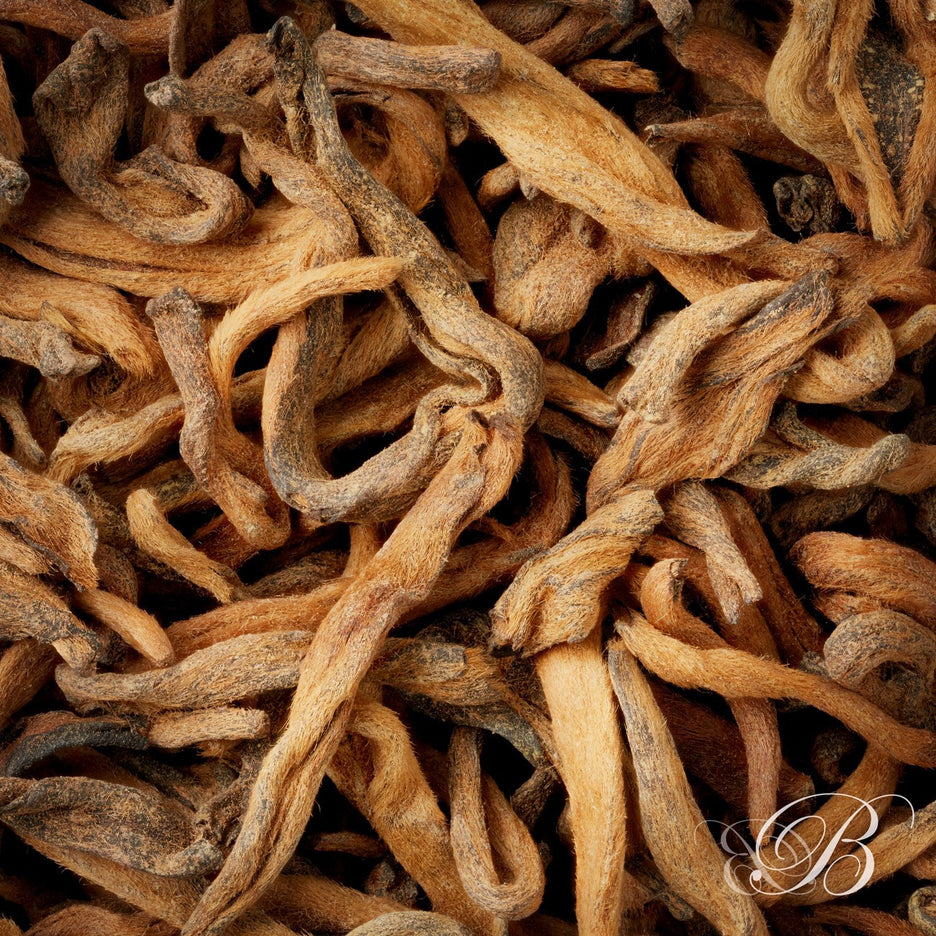
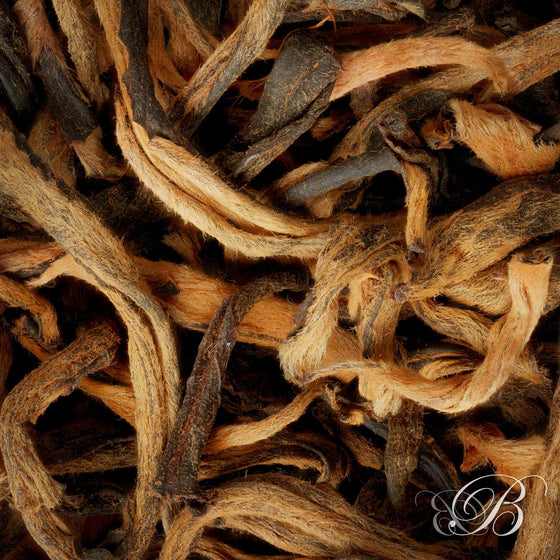
Contemplating the golden buds of the Golden 2011 is to travel even before brewing the tea. Their coppery, almost sun-like reflections speak volumes about the vitality of three-hundred-year-old tea trees and the patience of the spring pickers. Their warm glow evokes the beauty of the great Dian Hong teas of Yunnan, those prestigious teas whose leaves, covered in a golden down, seem woven from light. Their delicacy and rare luminosity give this Pu-erh an almost meditative dimension: a tea to be admired as much as prepared…
To fully understand what these buds represent, one must delve into the very language of tea, where words travel as far as the leaves themselves. What the West calls “black tea” actually corresponds, for the Chinese, to “red teas” (hóngchá), named for the amber color of their liquor. Conversely, the true “black teas” in China are fermented teas, such as Pu-erh, whose leaves are genuinely dark and whose processing is unique. To avoid this confusion, some sinologists and tea houses now translate hóngchá as “red teas,” a term more faithful to Chinese usage. Thus, in a few words, three different nomenclatures describe two realities: oxidized teas on the one hand, fermented teas on the other, each with its own history, geography, and cultural truth.
It is in this context that the 2011 Pu-Er Golden stands out not only as a great tea, but as a true event. It is born from a rare conjunction of terroir, craftsmanship, and time. In its profound liquor, a whole facet of nature and expertise is concentrated, becoming an almost initiatory experience.
While traditional Pu-erh teas blend whole leaves and stems, the Golden 2011 is composed solely of buds. This selection is so exacting that it represents no more than 2% of Yunnan's total Pu-erh production. These tips, picked in the spring, concentrate a unique chemical richness: fewer harsh tannins, and therefore no bitterness, but an abundance of complex amino acids (theanine, glutamate) that impart a velvety texture and sumptuous umami, the hallmark of exceptional teas.
The harvest itself is a sacred moment. The golden buds that shape the Golden 2011 are picked at the very first breath of spring, between the end of March and the first days of April, around the Qingming Festival. In the villages of Yunnan, this period is experienced as a rebirth: the mountain is "opened," the ancient tea trees are thanked, and a communal meal is shared. Each bud then carries the promise of a new season, a treasure of light born in the freshness of spring.
Then comes the transformation phase, and this is where another kind of miracle occurs. Unlike raw Pu-erh (Sheng), which ages naturally for decades through slow, imperceptible fermentation, cooked Pu-erh (Shou), such as the Golden 2011, undergoes an accelerated and controlled fermentation called wo dui. The buds are piled high, kept at 25–30°C, humidified to 60–70%, and then turned regularly for two to three months. During this process, natural microorganisms rapidly transform polyphenols into brown melanins and complex compounds, achieving in a few months what raw Pu-erh would take twenty to thirty years to accomplish. The result is a well-rounded, smooth liquor, ready to drink now, but still capable of slowly maturing over the years… up to twenty years and even more.
Food and tea pairings
Dare to experience the ultimate sensory journey: pair the 2011 Golden Pu-erh with a carefully selected cheese platter. Begin with a Brie de Melun. Its tender texture, bloomy rind, and rustic aromas melt into the woody and earthy notes of the tea, lingering on the palate with a hint of forest moss. Follow with a truffled Brillat-Savarin: the marriage of cream and truffle finds its echo in the velvety roundness of the tea, the umami inviting a unique, almost languorous, voluptuousness. Finally, let a 36-month-old Comté reveal its flavor crystals, its nuances of nuts and dried fruit, magnified by the depth of the Pu-erh. This sumptuous trio creates a harmony where the richness of the milk converses with the meditative layers of the tea, for an unforgettable tasting experience.
Recipe based on dark Pu-Er Golden tea
In autumn, let the 2011 Pu-Er Golden enhance a roasted venison fillet, drizzled with a tea-infused jus, to which you add blueberries or cranberries and a few wild peppercorns. Its dark, velvety liquor perfectly complements the rich flesh and wild character of the game, tempering its intensity without masking it. The woody notes of the tea take on a new dimension alongside the earthy aromas of the meat, creating a profound dialogue between the vegetal and the animal, worthy of the finest gastronomic tables.
10294
- Black tea Grand Cru -
This Pu-Erh black tea from China is the Grand Cru of the year 2011.
It is indeed the most refined of Pu-Erh teas, it is composed of golden buds.
Contemplating the golden buds of the Golden 2011 is to travel even before brewing the tea. Their coppery, almost sun-like reflections speak volumes about the vitality of three-hundred-year-old tea trees and the patience of the spring pickers. Their warm glow evokes the beauty of the great Dian Hong teas of Yunnan, those prestigious teas whose leaves, covered in a golden down, seem woven from light. Their delicacy and rare luminosity give this Pu-erh an almost meditative dimension: a tea to be admired as much as prepared…
To fully understand what these buds represent, one must delve into the very language of tea, where words travel as far as the leaves themselves. What the West calls “black tea” actually corresponds, for the Chinese, to “red teas” (hóngchá), named for the amber color of their liquor. Conversely, the true “black teas” in China are fermented teas, such as Pu-erh, whose leaves are genuinely dark and whose processing is unique. To avoid this confusion, some sinologists and tea houses now translate hóngchá as “red teas,” a term more faithful to Chinese usage. Thus, in a few words, three different nomenclatures describe two realities: oxidized teas on the one hand, fermented teas on the other, each with its own history, geography, and cultural truth.
It is in this context that the 2011 Pu-Er Golden stands out not only as a great tea, but as a true event. It is born from a rare conjunction of terroir, craftsmanship, and time. In its profound liquor, a whole facet of nature and expertise is concentrated, becoming an almost initiatory experience.
While traditional Pu-erh teas blend whole leaves and stems, the Golden 2011 is composed solely of buds. This selection is so exacting that it represents no more than 2% of Yunnan's total Pu-erh production. These tips, picked in the spring, concentrate a unique chemical richness: fewer harsh tannins, and therefore no bitterness, but an abundance of complex amino acids (theanine, glutamate) that impart a velvety texture and sumptuous umami, the hallmark of exceptional teas.
The harvest itself is a sacred moment. The golden buds that shape the Golden 2011 are picked at the very first breath of spring, between the end of March and the first days of April, around the Qingming Festival. In the villages of Yunnan, this period is experienced as a rebirth: the mountain is "opened," the ancient tea trees are thanked, and a communal meal is shared. Each bud then carries the promise of a new season, a treasure of light born in the freshness of spring.
Then comes the transformation phase, and this is where another kind of miracle occurs. Unlike raw Pu-erh (Sheng), which ages naturally for decades through slow, imperceptible fermentation, cooked Pu-erh (Shou), such as the Golden 2011, undergoes an accelerated and controlled fermentation called wo dui. The buds are piled high, kept at 25–30°C, humidified to 60–70%, and then turned regularly for two to three months. During this process, natural microorganisms rapidly transform polyphenols into brown melanins and complex compounds, achieving in a few months what raw Pu-erh would take twenty to thirty years to accomplish. The result is a well-rounded, smooth liquor, ready to drink now, but still capable of slowly maturing over the years… up to twenty years and even more.
10294
The Betjeman & Barton soul supplement
An exceptionally complex aged tea that has the elegance of improving with age.
You may also like

Black tea Yunnan Dian Hong T.G.F.O.P
Very delicate Chinese tea with notes of chocolate
Add to cart
Last viewed products