Formosa Green Jade

Formosa tea with a subtle taste

Regular price 25,55 €
Sale price 25,55 € Regular price 25,55 €
Unit price  per 
Tax included. Shipping calculated at checkout.
bulk packaging
Thé oolong Formose Vert Jade - Thés

Formosa Green Jade

100% secure payment

3 free samples with each order

Fast and free delivery for purchases over €65

Tasting moment:
Tasting moment: Tout au long de la journée
Infusion time:
Infusion time: 5-7 min
Water temperature:
Water temperature: 80°C

- Formosa with a subtle taste -


This blue-green tea has a subtle taste that is reminiscent of the dew fragrance on the waterside. It offers a golden liquor with notes of peach blossom.

It can be brewed several times.

30% fermentation.

In the misty hills of Nantou, it is said that a tea was born from the breath of a goddess. One spring night, as a solitary tea plant struggled to find its fragrance, the Jade Goddess, protector of mountains and springs, is said to have bowed down to it. Moved by its tenacity, she bestowed upon it a green light so pure that it seeped into the very heart of its leaves. In the morning, the tea growers discovered a transformed plant, its young shoots shining like polished jade. Thus, the legend whispers, was born this clear tea that soothes more than it stimulates, as if a touch of celestial serenity had infused its sap.

The official story, however, tells a completely different tale: that of the Cui Yu cultivar, "Green Jade," developed in 1981 by the Taiwanese Research Institute. The island was seeking to create an expressive, stable, and fragrant tea, capable of giving a distinct identity to the gardens of central Taiwan. And yet, despite its scientific origins, this tea undeniably possesses something mythical: a floral freshness, a limpid sweetness, an aromatic radiance that fully justifies the poetic stories the locals tell about it.

If Vert Jade Dung Ti holds such a central place in the Taiwanese imagination today, it is because it is part of a larger story: that of tea culture in Taiwan itself. Introduced in the 18th century by migrants from Fujian, the first tea plants were acclimatized in the mountains of central and northern Taiwan, where they found remarkably favorable conditions. Over generations, Taiwan developed a true school of oolong tea, founded on artisanal precision, an intimate understanding of the subtropical climate, and a unique ability to transform leaves into veritable floral compositions.

In the 1970s and 1990s, Taiwanese research gave rise to a new generation of cultivars (Cui Yu, Jin Xuan, Si Ji Chun) that would revolutionize the local style. Thanks to this blend of tradition and innovation, Taiwan excels in both lightly oxidized, bright, and vegetal oolongs and roasted Dong Ding-style oolongs, which are deeper and warmer. The island even produces some black teas of singular finesse, whose honeyed sweetness has become emblematic. Taiwan may not have the ancient tea trees of Yunnan, but it possesses something equally precious: exceptional craftsmanship, a meticulous attention to detail, and a sense of aromatic balance that has become its hallmark.

Jade Green Formosa is one of the gentlest expressions of this tradition. Its leaves, harvested more mature than those of high-altitude green teas, naturally have a low caffeine content, making it a particularly pleasant tea to enjoy in the afternoon or evening. This gentleness stems from the ripeness of the open leaves, the light oxidation that softens the polyphenols, and the varietal selection that prioritizes aromatic clarity over stimulating intensity. The result is a tea that promotes inner calm without jarring the mind.

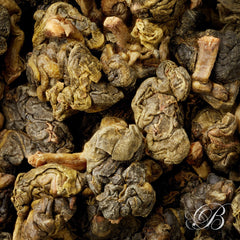
The transformation of Jade Green is a ballet of meticulous gestures: a light withering, a few stirrings to awaken the aromas, a brief fixation to preserve the green energy, then a gentle drying that locks the freshness within the heart of the small, rolled pearls. When brewed, these pearls slowly unfurl, releasing notes of white flowers, lily of the valley, sweet pea, and sometimes a milky touch depending on the season. The liquor, clear and luminous, evokes the sparkle of water gliding over a jade stone. In Taiwan, Formosa Jade Green is often offered as the first oolong to discover, so perfectly does it embody hospitality and gentleness. In the West, it appeals to green tea lovers seeking a rounded character, those who prefer clean yet soothing aromas, those looking for a tea that complements without overpowering.

Food and tea pairing
Imagine fresh pasta seasoned with spring herbs: parsley, tarragon, and spearmint. Serve it alongside a Formosa Jade Green tea brewed at 40°C, and the pairing unfolds with effortless grace. The tea's lily-of-the-valley notes complement the crystalline aromas of the herbs, while its creamy sweetness envelops the vegetal freshness of the pasta. Its lingering floral finish enhances the dish's delicacy and prolongs each bite in a symphony of mineral and fragrant nuances. A pairing where neither the tea nor the pasta overpowers itself, but where each reveals the other's hidden grace.

Recipe based on Formosa Green Jade Dung Ti Tea
Prepare a cold infusion of Formosa Vert Jade tea, then add the juice of a freshly squeezed lemon, a few strips of zest, and a drizzle of extra virgin olive oil. This luminous emulsion becomes the aromatic setting for a beautiful fillet of fine fish. Place a still-warm turbot steak on this bed of infusion: the warmth awakens the tea's aromas, the lemon's minerality balances them, while the floral freshness of the Vert Jade envelops the flesh with crystalline grace. With each bite, a subtle alchemy unfolds: the tea offers its nuances without ever overpowering, the lemon brightens, and the oil unites everything in perfect harmony.

10370

- Formosa with a subtle taste -


This blue-green tea has a subtle taste that is reminiscent of the dew fragrance on the waterside. It offers a golden liquor with notes of peach blossom.

It can be brewed several times.

30% fermentation.

In the misty hills of Nantou, it is said that a tea was born from the breath of a goddess. One spring night, as a solitary tea plant struggled to find its fragrance, the Jade Goddess, protector of mountains and springs, is said to have bowed down to it. Moved by its tenacity, she bestowed upon it a green light so pure that it seeped into the very heart of its leaves. In the morning, the tea growers discovered a transformed plant, its young shoots shining like polished jade. Thus, the legend whispers, was born this clear tea that soothes more than it stimulates, as if a touch of celestial serenity had infused its sap.

The official story, however, tells a completely different tale: that of the Cui Yu cultivar, "Green Jade," developed in 1981 by the Taiwanese Research Institute. The island was seeking to create an expressive, stable, and fragrant tea, capable of giving a distinct identity to the gardens of central Taiwan. And yet, despite its scientific origins, this tea undeniably possesses something mythical: a floral freshness, a limpid sweetness, an aromatic radiance that fully justifies the poetic stories the locals tell about it.

If Vert Jade Dung Ti holds such a central place in the Taiwanese imagination today, it is because it is part of a larger story: that of tea culture in Taiwan itself. Introduced in the 18th century by migrants from Fujian, the first tea plants were acclimatized in the mountains of central and northern Taiwan, where they found remarkably favorable conditions. Over generations, Taiwan developed a true school of oolong tea, founded on artisanal precision, an intimate understanding of the subtropical climate, and a unique ability to transform leaves into veritable floral compositions.

In the 1970s and 1990s, Taiwanese research gave rise to a new generation of cultivars (Cui Yu, Jin Xuan, Si Ji Chun) that would revolutionize the local style. Thanks to this blend of tradition and innovation, Taiwan excels in both lightly oxidized, bright, and vegetal oolongs and roasted Dong Ding-style oolongs, which are deeper and warmer. The island even produces some black teas of singular finesse, whose honeyed sweetness has become emblematic. Taiwan may not have the ancient tea trees of Yunnan, but it possesses something equally precious: exceptional craftsmanship, a meticulous attention to detail, and a sense of aromatic balance that has become its hallmark.

Jade Green Formosa is one of the gentlest expressions of this tradition. Its leaves, harvested more mature than those of high-altitude green teas, naturally have a low caffeine content, making it a particularly pleasant tea to enjoy in the afternoon or evening. This gentleness stems from the ripeness of the open leaves, the light oxidation that softens the polyphenols, and the varietal selection that prioritizes aromatic clarity over stimulating intensity. The result is a tea that promotes inner calm without jarring the mind.

The transformation of Jade Green is a ballet of meticulous gestures: a light withering, a few stirrings to awaken the aromas, a brief fixation to preserve the green energy, then a gentle drying that locks the freshness within the heart of the small, rolled pearls. When brewed, these pearls slowly unfurl, releasing notes of white flowers, lily of the valley, sweet pea, and sometimes a milky touch depending on the season. The liquor, clear and luminous, evokes the sparkle of water gliding over a jade stone. In Taiwan, Formosa Jade Green is often offered as the first oolong to discover, so perfectly does it embody hospitality and gentleness. In the West, it appeals to green tea lovers seeking a rounded character, those who prefer clean yet soothing aromas, those looking for a tea that complements without overpowering.

10370

The Betjeman & Barton soul supplement

A lightly oxidized Formosa oolong, like a promise of spring: light, floral, and delicate
persistent.