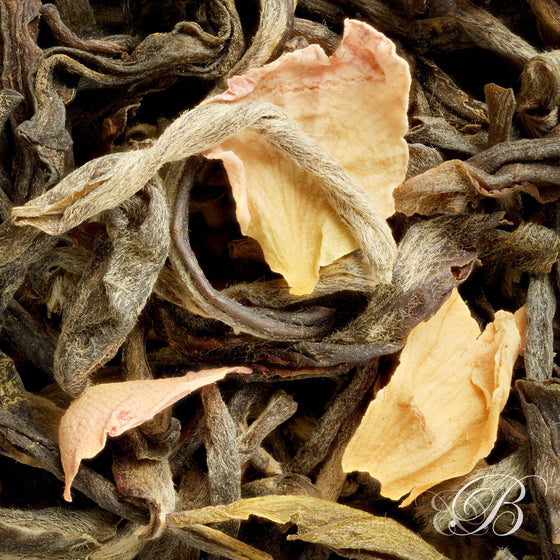
White tea Pai Mu Tan Organic Supérieur
Organic China tea with cocoa notes

White tea Pai Mu Tan Organic Supérieur
100% secure payment
3 free samples with each order
Fast and free delivery for purchases over €65
- White tea with notes of cocoa -
This white tea is cultivated in the Fujian province. The harvest is made by hand and only the bud and the 2 youngest sprouts are picked. This is a spring harvest.
White tea which offers a very sweet cup, with notes of cocoa.
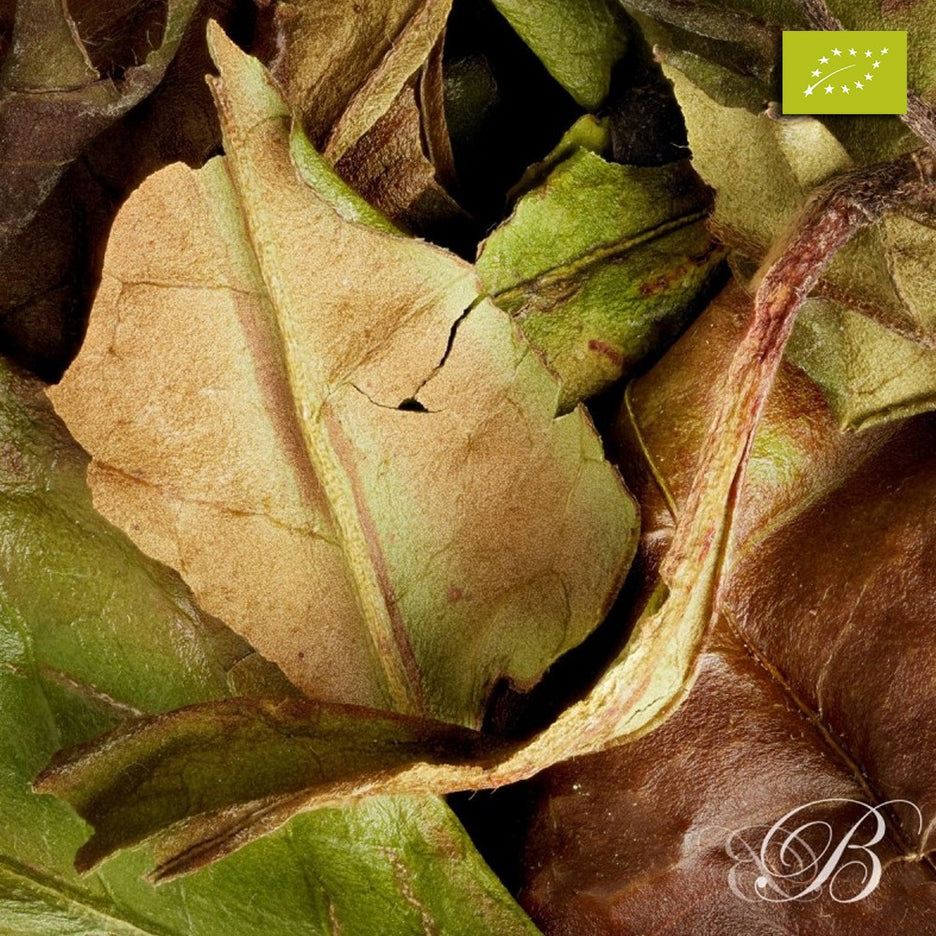
Velvety leaves.
An exceptional tea harvested in the spring, Superior Organic Pai Mu Tan embodies the quintessence of traditional Chinese teamaking. Harvesting takes place exclusively in the spring, generally between late March and April, when the young shoots emerge after their winter dormancy. This brief and precious period, comparable to a first flush, concentrates freshness, delicacy, and nutritional richness in each leaf.
Its name, literally "white peony," evokes both the appearance of the infused leaves, which unfurl like a corolla in the teapot, and the characteristic floral notes of this grand cru tea. According to legend, the goddess Pai Mu Tan offered this tea to a gravely ill mortal, who miraculously recovered after drinking it. This story, passed down through generations, has contributed to forging Pai Mu Tan's reputation as an elixir of health and longevity.
Historically reserved for the Chinese imperial courts, white tea was long considered a nectar of the elite, a symbol of purity and refinement. It was only from the 1870s onward that the production of Pai Mu Tan developed in Shuiji County, and then in the 1920s in Zhenghe, which quickly became one of the main producing regions. For centuries, the rarity of white tea and its artisanal production methods restricted it to the most privileged circles. It wasn't until the 1890s that China began exporting white tea to the West, where it quickly won over European connoisseurs seeking authenticity and delicacy.
The production of Pai Mu Tan follows a deceptively simple yet absolutely rigorous process. Unlike other types of tea, white tea undergoes minimal processing: the freshly picked leaves are gently laid out to wither naturally in the sun or shade, a process that can last from one to three days depending on the weather. This crucial step allows for slight enzymatic oxidation, which develops the characteristic aromas without altering the cellular structure of the leaves. The leaves are then dried at a low temperature to preserve their aromatic compounds and natural antioxidants. No rolling, no roasting, no intrusive mechanical intervention: Pai Mu Tan expresses nature in its purest form.
The traditional cultivars used for this grand cru tea are the "Da Bai" (great white) varieties, notably Fuding Da Bai in eastern Fujian and Zhenghe Da Bai in the north of the province. These tea plants, recognized nationally since 1985, produce particularly plump and downy buds, rich in aromatic compounds. The Fuding terroir, with its misty climate, temperate altitudes, and proximity to the sea, creates an ideal microclimate for the development of these young shoots, giving them exceptional sweetness and aromatic complexity.
In China, Pai Mu Tan is often associated with prosperity, beauty, and femininity, symbolized by the white peony. It embodies elegance and nobility, values at the heart of Chinese tea culture. Even today, Pai Mu Tan remains one of the world's most prized white teas, appreciated in both Europe and Asia for its subtle aromatic profile, velvety texture, and health benefits.
Food and tea pairings
To enhance the floral sweetness of Superior Organic Pai Mu Tan, pair it with a light pavlova topped with lychee mousse, a few fresh raspberries, and a rose coulis. The delicate white tea, with its subtle notes of cocoa and white flowers, amplifies the sweet exoticism of the lychee while balancing the delicate acidity of the raspberries. This ethereal pairing creates a harmonious dialogue between fruity freshness and floral elegance, prolonging each bite with a velvety smoothness.
Recipe based on superior organic Chinese white tea, Pai Mu Tan
Infuse the Superior Organic Pai Mu Tan in cold water and let it steep for a few hours in the refrigerator, gradually revealing its floral and cocoa notes. For a velvety-smooth mocktail, combine this nectar with lychee juice, a few drops of rose syrup, and invigorating lime. Pour over ice, top with sparkling water, and discover this symphony where the delicate floral and cocoa notes of white tea embrace the sweet exoticism of lychee—a ballet of freshness and poetry.
10268
- White tea with notes of cocoa -
This white tea is cultivated in the Fujian province. The harvest is made by hand and only the bud and the 2 youngest sprouts are picked. This is a spring harvest.
White tea which offers a very sweet cup, with notes of cocoa.
Velvety leaves.
An exceptional tea harvested in the spring, Superior Organic Pai Mu Tan embodies the quintessence of traditional Chinese teamaking. Harvesting takes place exclusively in the spring, generally between late March and April, when the young shoots emerge after their winter dormancy. This brief and precious period, comparable to a first flush, concentrates freshness, delicacy, and nutritional richness in each leaf.
Its name, literally "white peony," evokes both the appearance of the infused leaves, which unfurl like a corolla in the teapot, and the characteristic floral notes of this grand cru tea. According to legend, the goddess Pai Mu Tan offered this tea to a gravely ill mortal, who miraculously recovered after drinking it. This story, passed down through generations, has contributed to forging Pai Mu Tan's reputation as an elixir of health and longevity.
Historically reserved for the Chinese imperial courts, white tea was long considered a nectar of the elite, a symbol of purity and refinement. It was only from the 1870s onward that the production of Pai Mu Tan developed in Shuiji County, and then in the 1920s in Zhenghe, which quickly became one of the main producing regions. For centuries, the rarity of white tea and its artisanal production methods restricted it to the most privileged circles. It wasn't until the 1890s that China began exporting white tea to the West, where it quickly won over European connoisseurs seeking authenticity and delicacy.
The production of Pai Mu Tan follows a deceptively simple yet absolutely rigorous process. Unlike other types of tea, white tea undergoes minimal processing: the freshly picked leaves are gently laid out to wither naturally in the sun or shade, a process that can last from one to three days depending on the weather. This crucial step allows for slight enzymatic oxidation, which develops the characteristic aromas without altering the cellular structure of the leaves. The leaves are then dried at a low temperature to preserve their aromatic compounds and natural antioxidants. No rolling, no roasting, no intrusive mechanical intervention: Pai Mu Tan expresses nature in its purest form.
The traditional cultivars used for this grand cru tea are the "Da Bai" (great white) varieties, notably Fuding Da Bai in eastern Fujian and Zhenghe Da Bai in the north of the province. These tea plants, recognized nationally since 1985, produce particularly plump and downy buds, rich in aromatic compounds. The Fuding terroir, with its misty climate, temperate altitudes, and proximity to the sea, creates an ideal microclimate for the development of these young shoots, giving them exceptional sweetness and aromatic complexity.
In China, Pai Mu Tan is often associated with prosperity, beauty, and femininity, symbolized by the white peony. It embodies elegance and nobility, values at the heart of Chinese tea culture. Even today, Pai Mu Tan remains one of the world's most prized white teas, appreciated in both Europe and Asia for its subtle aromatic profile, velvety texture, and health benefits.
10268
The Betjeman & Barton soul supplement
A very delicate white tea where floral notes and a hint of cocoa vibrate.
You may also like
Last viewed products
Un raffinement et très discret . Parfait à mon goût.