White tea White Monkey Organic

Organic China tea in a sweet and aromatic cup

Regular price 23,70 €
Sale price 23,70 € Regular price 23,70 €
Unit price  per 
Tax included. Shipping calculated at checkout.
bulk packaging
Thé blanc chinois White Monkey bio - Thés

White tea White Monkey Organic

100% secure payment

3 free samples with each order

Fast and free delivery for purchases over €65

Tasting moment:
Tasting moment: Tout au long de la journée
Infusion time:
Infusion time: 8 min
Water temperature:
Water temperature: 70°C

- White tea with smooth and aromatic cup -


This white tea is cultivated in the Fujian Province, more precisely in the Tai-Mu mountains. Its downy leaves offer a smooth and aromatic cup.

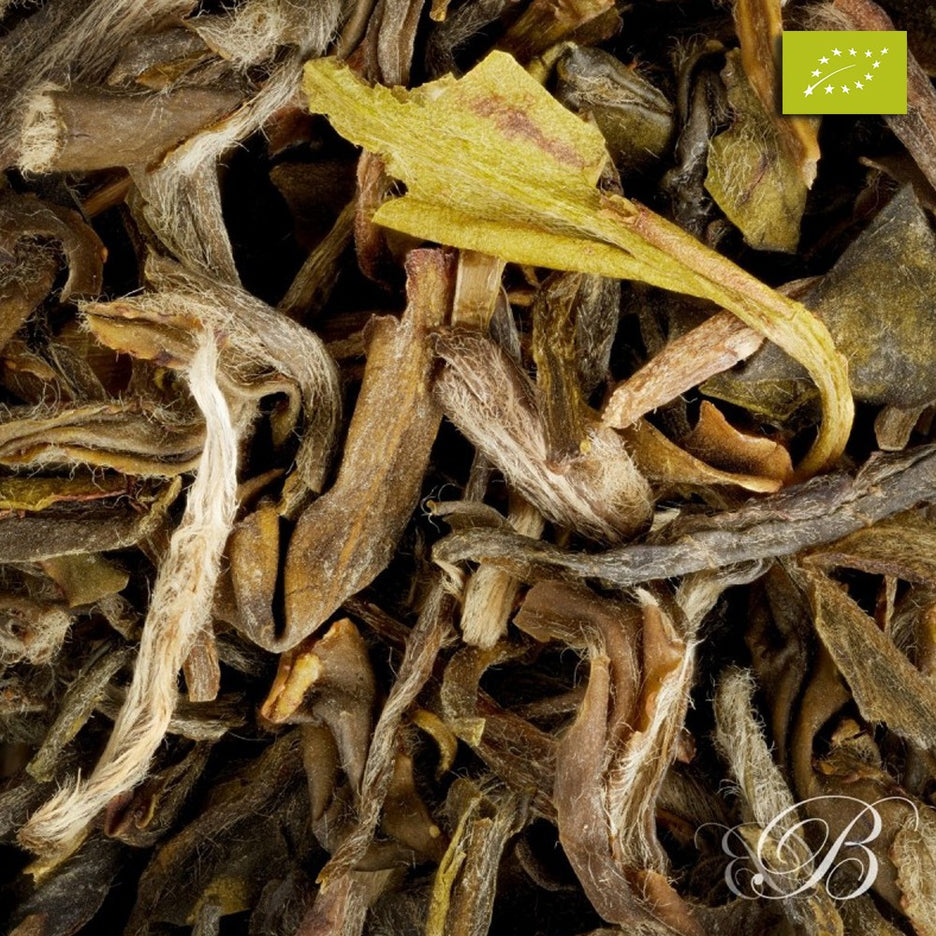
Very light green leaves with multiple buds.

On the steep slopes of the Taimu Mountains, where the paths crumble above the void, a long-standing story has circulated: it is said that long ago, on these slopes so precipitous that no tea picker dared venture there, lived monkeys with snow-white fur. Agile and light, they leaped from ledge to ledge, where wild tea plants grew, beyond human reach. The villagers, fascinated by their dexterity, eventually tamed them, teaching them to pluck the most precious buds in exchange for a few peanuts. Thus was born White Monkey tea, whose name pays homage not to the hand of man, but to that of a mountain companion.

Charming as it is, this legend illuminates a deeper dimension. The White Monkey reflects the Taoist principle of wu wei, right action, unforced action, that which allows nature to do its work without constraint. In this philosophy, the wise person does not dominate the world, but simply harmonizes with its rhythm. The gathering monkey, in its instinctive spontaneity, then becomes a perfect image of this harmony: it calculates nothing, forces nothing, it follows its nature, and it is precisely in this way that it gathers what humankind could not reach.

Even today, the White Monkey harvest bears the mark of this delicate nature. From late March to early April, in the first hours of the day, before the heat can diminish the tenderness of the young shoots, the pickers (mainly women from the villages of Fuding) move between the rows of tea bushes to pick a bud accompanied by one or two emerging leaves. These are no longer wild tea bushes: the Fuding Da Bai cultivar has long since replaced the trees of the past, cultivated on hills at altitudes of 300 to 1,200 meters. The gardens cover seventeen districts around Fuding and supply nearly two thousand factories. The harvest window, rarely more than two weeks, concentrates in each leaf a springtime freshness that will not be found again until a year later.

This short timeframe necessitates close proximity between the gardens and the workshops. The leaves are fragile, beginning to oxidize as soon as they are picked, and would not withstand any long transport. The processing facilities are therefore located as close as possible to the plantations, allowing the pickers to leave their baskets there just a few hours after harvesting.

Curiously, in China, organic White Monkey tea remains a niche product, consumed far less than green or oolong teas. A large portion of Fuding's production is exported to the West, particularly France, where white tea has established itself as a product of excellence associated with purity, health, and elegance. Organic White Monkey, born in the hands of the women of Fuding, thus often ends its journey in Parisian tea rooms rather than in Chinese teapots.

Beneath its delicate appearance, however, organic White Monkey holds a surprise: the young, tender leaf contains a much higher amount of caffeine than its airy flavor would suggest. The plant naturally concentrates caffeine in its buds to protect itself from insects: it is precisely these tender shoots that the pickers select for organic White Monkey. White tea thus presents a dual nature: apparent sweetness, profound energy. A paradox that stimulates the mind while simultaneously inviting calm.

In Taoist thought, white tea corresponds to the Water element: soothing, regenerating, capable of extinguishing excess inner fire. Drinking it becomes a practice of contemplation, nourished by cha qi, the subtle energy of tea. To drink white tea is to accept slowing down, to let thoughts infuse like leaves in hot water, to practice the delicate art of doing nothing… and receiving everything.

Food and tea pairings
The subtle sweetness and vegetal notes of organic White Monkey tea blend naturally with steamed shrimp dressed with a squeeze of lemon. Its aromas of tender peas and fresh chestnut mingle with the delicately sweet flesh of the crustacean. The tea's springtime bouquet complements the subtle brininess of the shrimp, while its rich nuances enhance the lemony sauce. Its rounded, slightly animalic character envelops the marine flavors without overpowering them, creating a rare balance between mineral freshness and floral elegance.

Recipe based on organic White Monkey white tea from China
To make a refreshing vinaigrette, prepare a cooled White Monkey infusion, then blend it with cider vinegar, fruity olive oil, and a touch of mild mustard. Drizzle this subtle vinaigrette over your steamed spring vegetables (peas, baby carrots, young broad beans). The tea's aromas enhance the vegetables' fresh, spring-like flavor, while the discreet floral notes reveal the natural sweetness of each vegetable without overpowering it. A graceful marriage of tea and spring's bounty.

10256

- White tea with smooth and aromatic cup -


This white tea is cultivated in the Fujian Province, more precisely in the Tai-Mu mountains. Its downy leaves offer a smooth and aromatic cup.

Very light green leaves with multiple buds.

On the steep slopes of the Taimu Mountains, where the paths crumble above the void, a long-standing story has circulated: it is said that long ago, on these slopes so precipitous that no tea picker dared venture there, lived monkeys with snow-white fur. Agile and light, they leaped from ledge to ledge, where wild tea plants grew, beyond human reach. The villagers, fascinated by their dexterity, eventually tamed them, teaching them to pluck the most precious buds in exchange for a few peanuts. Thus was born White Monkey tea, whose name pays homage not to the hand of man, but to that of a mountain companion.

Charming as it is, this legend illuminates a deeper dimension. The White Monkey reflects the Taoist principle of wu wei, right action, unforced action, that which allows nature to do its work without constraint. In this philosophy, the wise person does not dominate the world, but simply harmonizes with its rhythm. The gathering monkey, in its instinctive spontaneity, then becomes a perfect image of this harmony: it calculates nothing, forces nothing, it follows its nature, and it is precisely in this way that it gathers what humankind could not reach.

Even today, the White Monkey harvest bears the mark of this delicate nature. From late March to early April, in the first hours of the day, before the heat can diminish the tenderness of the young shoots, the pickers (mainly women from the villages of Fuding) move between the rows of tea bushes to pick a bud accompanied by one or two emerging leaves. These are no longer wild tea bushes: the Fuding Da Bai cultivar has long since replaced the trees of the past, cultivated on hills at altitudes of 300 to 1,200 meters. The gardens cover seventeen districts around Fuding and supply nearly two thousand factories. The harvest window, rarely more than two weeks, concentrates in each leaf a springtime freshness that will not be found again until a year later.

This short timeframe necessitates close proximity between the gardens and the workshops. The leaves are fragile, beginning to oxidize as soon as they are picked, and would not withstand any long transport. The processing facilities are therefore located as close as possible to the plantations, allowing the pickers to leave their baskets there just a few hours after harvesting.

Curiously, in China, organic White Monkey tea remains a niche product, consumed far less than green or oolong teas. A large portion of Fuding's production is exported to the West, particularly France, where white tea has established itself as a product of excellence associated with purity, health, and elegance. Organic White Monkey, born in the hands of the women of Fuding, thus often ends its journey in Parisian tea rooms rather than in Chinese teapots.

Beneath its delicate appearance, however, organic White Monkey holds a surprise: the young, tender leaf contains a much higher amount of caffeine than its airy flavor would suggest. The plant naturally concentrates caffeine in its buds to protect itself from insects: it is precisely these tender shoots that the pickers select for organic White Monkey. White tea thus presents a dual nature: apparent sweetness, profound energy. A paradox that stimulates the mind while simultaneously inviting calm.

In Taoist thought, white tea corresponds to the Water element: soothing, regenerating, capable of extinguishing excess inner fire. Drinking it becomes a practice of contemplation, nourished by cha qi, the subtle energy of tea. To drink white tea is to accept slowing down, to let thoughts infuse like leaves in hot water, to practice the delicate art of doing nothing… and receiving everything.

10256

The Betjeman & Barton soul supplement

Our Organic White Monkey is the finesse of the Chinese peaks in a cup of rare freshness and purity.