Black tea Panyong Golden
Delicate, golden and sweet China tea

Black tea Panyong Golden
100% secure payment
3 free samples with each order
Fast and free delivery for purchases over €65
- Black tea with young sprouts -
This black tea from China is cultivated in the Tai-Mu mountain, located at the East of the Fujian Province. It is picked only in April, when the young sprouts grow.
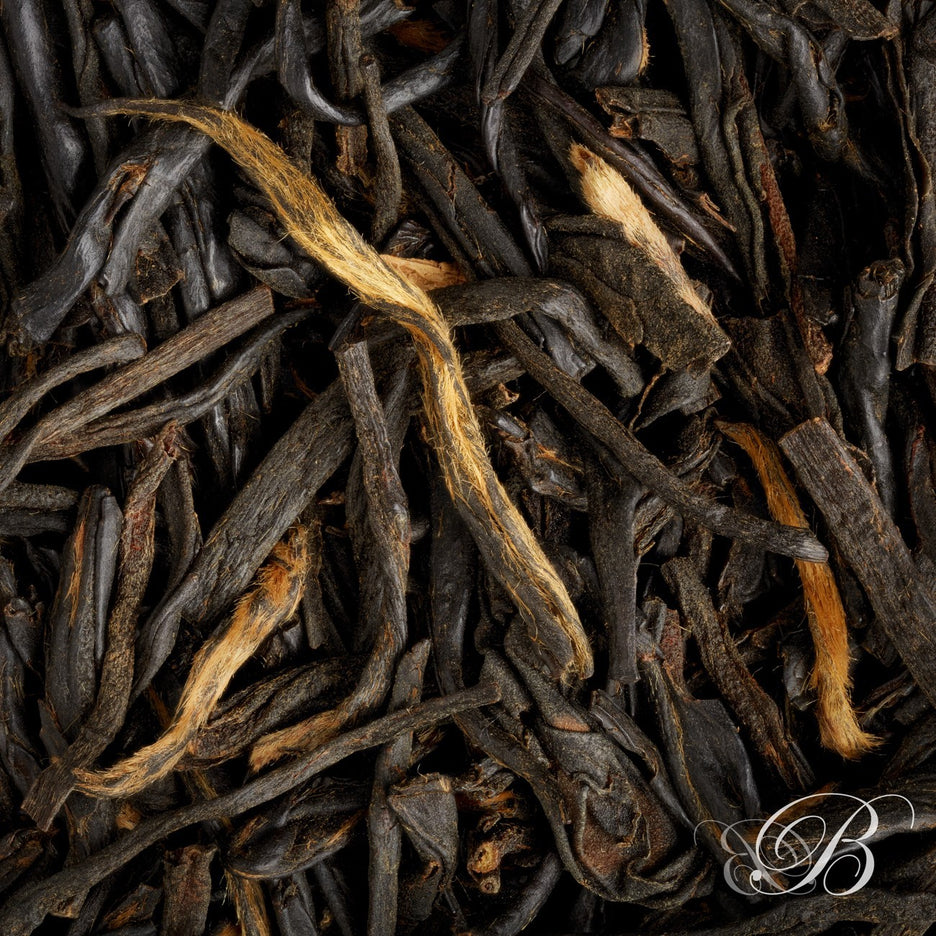
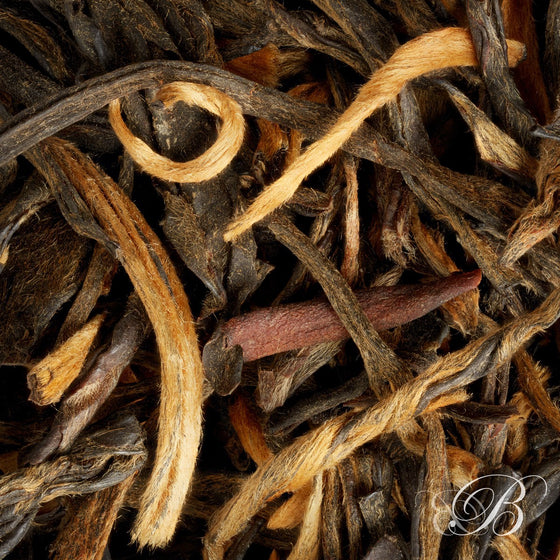
Long leaves with golden tips.
An exceptional tea grown at high altitude, Panyong Golden is harvested exclusively in April, at the precise moment when the first shoots emerge. This spring harvest, comparable to a first flush of Fujian tea, gives this variety a rare aromatic richness, the result of a youthful plant life that concentrates freshness, finesse, and energy.
The very essence of its name directly reflects Chinese craftsmanship. Panyong means “skillfully crafted tea,” a term that already reveals the care required in its production. This type of tea belongs to the “gongfu” (or “congou”) tea family, a word which, in Chinese, denotes work carried out with mastery, patience, and precision—the same term used for the tea ceremony.
And this is no coincidence: each Panyong leaf undergoes a rigorous process, including withering, rolling, fermentation, and drying. This meticulous sequence distinguishes genuine Panyong teas from more ordinary black teas, which are produced with less care.
This expertise is coupled with a respectful approach to the tea leaf. While some Chinese black teas undergo excessive roasting, Panyong Golden favors a gentler method. Controlled fermentation and traditional charcoal drying preserve the natural delicacy of the young buds, allowing their aromatic compounds to develop without harshness.
Unlike many teas made from a blend of cultivars, Panyong Golden is considered a monocultivar. This meticulous craftsmanship, focused on a single plant material, reveals the full, original elegance of the young shoots. The resulting liquor, smooth and velvety, stands out distinctly from the more robust or woody profiles of Keemun and Yunnan teas.
While its roots are Chinese, its global renown owes much to Europe. From the mid-19th century, Panyong Golden conquered Western markets, a time when its exports reached record highs. At its peak, it was served at the British royal court and acclaimed by many European countries. This grand cru remains a benchmark in Europe today for its refinement, much more so than in China, where green teas traditionally hold pride of place.
Its terroir also contributes to its unique character. The proximity of the sea envelops the vineyards in salty mists, providing constant humidity, tempering excessive heat, and enriching the soil. This maritime climate, combined with the altitude, promotes slow ripening and exceptional aromatic concentration. In the cup, this harmony translates into a rare balance, a richness of flavor that defines the identity of Panyong Golden.
Legend, finally, adds its touch of mystery… The ancient pickers are said to have reserved the earliest spring harvests for the imperial palaces, a symbol of renewal and perfection. Thus, the reputation of Panyong is said to have been forged: a nectar of the elite, sometimes associated in popular tales with almost mystical harvests where nature and humankind unite their efforts to preserve the nobility of the vintage.
Food and tea pairings
To fully appreciate the magic of this exceptional tea, enjoy it at room temperature paired with pan-seared foie gras, accompanied by a fine brunoise of caramelized pears and a honey tea reduction. The tea's smoothness complements the richness of the foie gras, while the caramelized and fruity notes enhance the indulgence. This harmonious pairing allows the amber liquor of Panyong to blend seamlessly into a refined structure, creating a sensory dialogue between strength, delicacy, and a lingering finish.
Recipe using Panyong Golden black tea from China
To create a delicate Panyong reduction, infuse a generous spoonful of leaves in a little simmering water, covered, then strain the amber-colored elixir. Add a drizzle of acacia honey, perhaps a touch of cider vinegar or a splash of apple juice for freshness and acidity, and reduce over low heat until you obtain a glossy, almost caramel-like syrup. This silky reduction is then used to coat your pan-seared foie gras, enhancing its melting warmth with its characteristic notes.
10235
- Black tea with young sprouts -
This black tea from China is cultivated in the Tai-Mu mountain, located at the East of the Fujian Province. It is picked only in April, when the young sprouts grow.
Long leaves with golden tips.
An exceptional tea grown at high altitude, Panyong Golden is harvested exclusively in April, at the precise moment when the first shoots emerge. This spring harvest, comparable to a first flush of Fujian tea, gives this variety a rare aromatic richness, the result of a youthful plant life that concentrates freshness, finesse, and energy.
The very essence of its name directly reflects Chinese craftsmanship. Panyong means “skillfully crafted tea,” a term that already reveals the care required in its production. This type of tea belongs to the “gongfu” (or “congou”) tea family, a word which, in Chinese, denotes work carried out with mastery, patience, and precision—the same term used for the tea ceremony.
And this is no coincidence: each Panyong leaf undergoes a rigorous process, including withering, rolling, fermentation, and drying. This meticulous sequence distinguishes genuine Panyong teas from more ordinary black teas, which are produced with less care.
This expertise is coupled with a respectful approach to the tea leaf. While some Chinese black teas undergo excessive roasting, Panyong Golden favors a gentler method. Controlled fermentation and traditional charcoal drying preserve the natural delicacy of the young buds, allowing their aromatic compounds to develop without harshness.
Unlike many teas made from a blend of cultivars, Panyong Golden is considered a monocultivar. This meticulous craftsmanship, focused on a single plant material, reveals the full, original elegance of the young shoots. The resulting liquor, smooth and velvety, stands out distinctly from the more robust or woody profiles of Keemun and Yunnan teas.
While its roots are Chinese, its global renown owes much to Europe. From the mid-19th century, Panyong Golden conquered Western markets, a time when its exports reached record highs. At its peak, it was served at the British royal court and acclaimed by many European countries. This grand cru remains a benchmark in Europe today for its refinement, much more so than in China, where green teas traditionally hold pride of place.
Its terroir also contributes to its unique character. The proximity of the sea envelops the vineyards in salty mists, providing constant humidity, tempering excessive heat, and enriching the soil. This maritime climate, combined with the altitude, promotes slow ripening and exceptional aromatic concentration. In the cup, this harmony translates into a rare balance, a richness of flavor that defines the identity of Panyong Golden.
Legend, finally, adds its touch of mystery… The ancient pickers are said to have reserved the earliest spring harvests for the imperial palaces, a symbol of renewal and perfection. Thus, the reputation of Panyong is said to have been forged: a nectar of the elite, sometimes associated in popular tales with almost mystical harvests where nature and humankind unite their efforts to preserve the nobility of the vintage.
10235
The Betjeman & Barton soul supplement
A magnificent tea emblematic of Fujian, recognizable by its beautiful dark needles and its generous, malty notes.
You may also like

Black tea Yunnan Dian Hong T.G.F.O.P
Very delicate Chinese tea with notes of chocolate
Add to cart

Black tea Celestial Yunnan T.GF.O.P
Chinese tea with strong liqueur
Add to cart

Black tea Yunnan Golden Organic G.F.O.P Sup
Organic China tea with a strong flavor
Add to cart
Last viewed products
C’est le thé favori du petit déjeuner depuis des années.
Cher client,
Nous vous remercions pour votre commentaire. Avoir des clients comme vous fait l’histoire de notre Maison.