Chinese Green Tea Taiping Houkui First 2025
100% secure payment
3 free samples with each order
Fast and free delivery for purchases over €65
Color: Green tea
Origin: Hou Keng Village, Huangshan District, Anhui Province, East China.
Region: Born on the misty slopes surrounding Tai Ping Lake, on the northern borders of the legendary Yellow Mountains, this Taiping Houkui first flush 2025 is rooted in one of China's most jealously guarded terroirs. The Hou Keng gardens, which Betjeman and Barton has selected in its rarest version (what Chinese connoisseurs call "the secret garden"), are located at nearly 900 meters above sea level, where the morning mists veil the tea plants with a soft, diffused light, delaying the awakening of the buds and concentrating an incomparable aromatic complexity in each leaf. The deep, clay-granitic, well-drained soils offer the large-leaf cultivar conditions that cannot be replicated anywhere else.
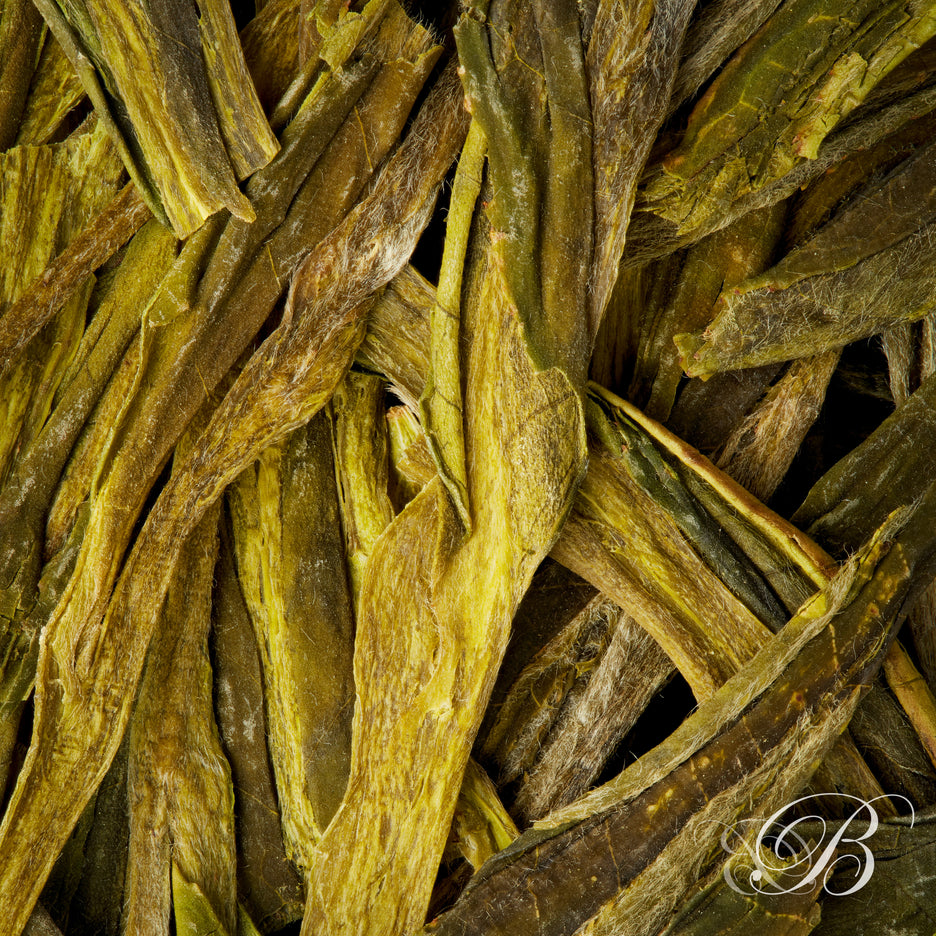
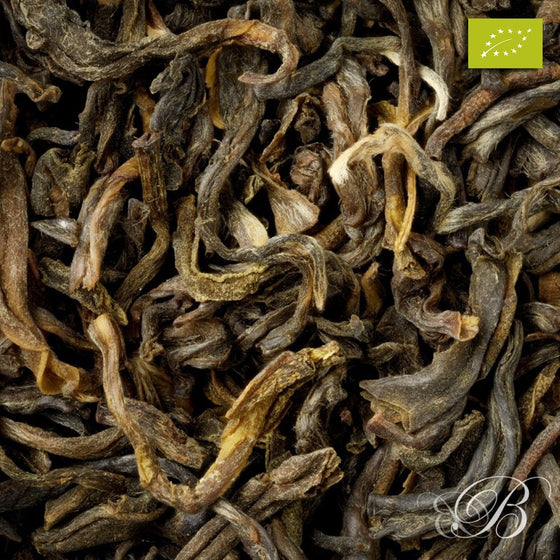
Appearance of dried leaves: Whole, long, and perfectly flat leaves, among the largest in the tea world. Their "jade sword" silhouette (a bud caught between two leaves) is immediately recognizable. The surface, finely marked by the imprint of bamboo and woven cotton, forms a delicate network of veins. Their deep green, slightly marbled with light jade, highlights the spectacular character of this grand cru.
Infusion: The liquor unfolds in a luminous light green of almost crystalline clarity, crossed with slightly golden jade reflections.
Tasting notes: When tasted, this green tea will surprise you with its vegetal fragrance and great delicacy, with peach aromas and very fresh lily of the valley notes. On the nose, the dry leaves offer an airy bouquet: fine herbs, white flowers, green orchid. In the mouth, the texture is surprisingly silky: the attack is fresh and precise, then the liquor unfolds with aromas of white peach, fresh almond, and tender hazelnut, crossed with a subtle and persistent wet stone minerality. No bitterness, no harshness: Chinese tasters speak here of Hou Yun, an almost caressing length on the palate that lingers long after the last sip.
Tasting moment: This first flush 2025 has a moderate level of theine, softened by a beautiful natural concentration of L-theanine characteristic of early high-altitude harvests. It ideally accompanies studious mornings and contemplative early afternoons, bringing clarity of mind and serenity.
To honor the nobility of its large leaves, opt for a tall straight glass or an open-filter teapot that gives them plenty of space to unfurl; a tea ball is obviously to be avoided.
- In a glass (traditional method): first pour water at 80–85 °C, then place the leaves on the surface, upright if possible. They slowly sink, gradually releasing their aromas. Infuse for 2 to 3 minutes; repeat 3 to 4 times, slightly adjusting the time.
- For Western infusion: 3 to 4 g for 250 ml, 2 minutes at 80 °C. The cup immediately expresses itself in a clear, vegetal register, with great spring finesse.
Among China's great green teas, few have a history that combines imperial chronicle, mountain legend, and diplomatic triumph. Taiping Houkui is one such tea, and today ranks among the world's greatest green teas, both for its prestige and the uniqueness of its craftsmanship.
Its name already tells a whole story. Taiping refers to its county of origin and evokes the serene peace of these valleys suspended between sky and lake. Hou means monkey (referring to the native village of Hou Keng, the "monkey well") and Kui, the chief, the best, the one who dominates. Together, these characters paint a portrait: the sovereign tea born from the land of monkeys.
The harvesting of Taiping Houkui follows an almost immutable ritual: it lasts only a few days at the very beginning of spring, when the young shoots offer exactly one bud and two perfectly formed leaves. In the early hours of the day, before the sun rises, the tea pickers scour the slopes of Hou Keng to select only these exceptional shoots, rejecting all the rest. This brief and demanding harvest window explains why every batch worthy of the name Taiping Houkui is not only rare but intimately linked to a precise moment of the year, like a vintage of light and climate captured at the right instant.
The documented history of this tea begins at the turn of the 20th century, when a local tea master perfected the local technique of pointed teas by retaining only the best: strictly one bud and two leaves, from high-altitude plants. The result was so superior to other productions in the vicinity that it immediately stood out and earned its own name. This initial demand, now ritualized, has never wavered.
Public consecration arrived in 1910, in Nanjing, at the Nanyang Industrial Exhibition, where a few kilograms of the noblest batch from Hou Keng caused such an ovation that the masters decided to forever reserve the name Taiping Houkui for their terroir. Five years later, the gold medal won at the San Francisco Universal Exhibition propelled this young tea to legendary status and established it permanently in the very exclusive circle of the "ten famous teas of China," among the rarest representatives of this plant aristocracy.
More recently, it has attained an even more singular status: that of a state tea. Chosen as a diplomatic gift by the highest Chinese authorities, it is offered during official meetings to foreign heads of state, as a concentrate of the most refined tea culture: a gesture of peace, patience, and excellence. The traditional craftsmanship of Taiping Houkui is now recognized as a national intangible cultural heritage in China, a true living treasure that is protected as much as it is celebrated.
Tea and Food Pairing
For a pairing that is both spring-like and refined, marry this 2025 first flush Taiping Houkui with a delicate white fish – sea bass, pollack, or John Dory – lightly seared, served on a bed of green asparagus, peas, and barely crunchy broad beans. The tea's fresh vegetal notes echo the fish's delicacy, while its lily-of-the-valley and white peach notes accentuate the subtle flavors of seasonal vegetables, like a touch of light added to the dish. Served in a warmed carafe alongside the plate, it advantageously replaces a very dry white wine, providing a crystalline, alcohol-free length that cleanses the palate between each bite.
Recipe with Taiping Honkui First Flush 2025 green tea
Taiping Houkui Jelly, Yuzu Zest
To celebrate its delicate and sophisticated profile, make a Taiping Houkui jelly with green citrus fruits, to be served as a refreshing and refined interlude.
- Cold infuse the Taiping Houkui for 6 hours (6g for 500ml of filtered water) to obtain a smooth, clear liqueur of great vegetal purity.
- Filter the infusion, then gently warm a portion with a little acacia honey and the necessary agar-agar, mixing delicately.
- Combine with the rest of the cold infusion, add some very fine lime and yuzu zest, then pour into tasting verrines.
- Allow to set in the refrigerator: the jelly, translucent and vibrant with green and citrus notes, is enjoyed as a discreet little luxury, at the crossroads of fine pastry and the art of tea.
Color: Green tea
Origin: Hou Keng Village, Huangshan District, Anhui Province, East China.
Region: Born on the misty slopes surrounding Tai Ping Lake, on the northern borders of the legendary Yellow Mountains, this Taiping Houkui first flush 2025 is rooted in one of China's most jealously guarded terroirs. The Hou Keng gardens, which Betjeman and Barton has selected in its rarest version (what Chinese connoisseurs call "the secret garden"), are located at nearly 900 meters above sea level, where the morning mists veil the tea plants with a soft, diffused light, delaying the awakening of the buds and concentrating an incomparable aromatic complexity in each leaf. The deep, clay-granitic, well-drained soils offer the large-leaf cultivar conditions that cannot be replicated anywhere else.
Appearance of dried leaves: Whole, long, and perfectly flat leaves, among the largest in the tea world. Their "jade sword" silhouette (a bud caught between two leaves) is immediately recognizable. The surface, finely marked by the imprint of bamboo and woven cotton, forms a delicate network of veins. Their deep green, slightly marbled with light jade, highlights the spectacular character of this grand cru.
Infusion: The liquor unfolds in a luminous light green of almost crystalline clarity, crossed with slightly golden jade reflections.
Tasting notes: When tasted, this green tea will surprise you with its vegetal fragrance and great delicacy, with peach aromas and very fresh lily of the valley notes. On the nose, the dry leaves offer an airy bouquet: fine herbs, white flowers, green orchid. In the mouth, the texture is surprisingly silky: the attack is fresh and precise, then the liquor unfolds with aromas of white peach, fresh almond, and tender hazelnut, crossed with a subtle and persistent wet stone minerality. No bitterness, no harshness: Chinese tasters speak here of Hou Yun, an almost caressing length on the palate that lingers long after the last sip.
Tasting moment: This first flush 2025 has a moderate level of theine, softened by a beautiful natural concentration of L-theanine characteristic of early high-altitude harvests. It ideally accompanies studious mornings and contemplative early afternoons, bringing clarity of mind and serenity.
To honor the nobility of its large leaves, opt for a tall straight glass or an open-filter teapot that gives them plenty of space to unfurl; a tea ball is obviously to be avoided.
- In a glass (traditional method): first pour water at 80–85 °C, then place the leaves on the surface, upright if possible. They slowly sink, gradually releasing their aromas. Infuse for 2 to 3 minutes; repeat 3 to 4 times, slightly adjusting the time.
- For Western infusion: 3 to 4 g for 250 ml, 2 minutes at 80 °C. The cup immediately expresses itself in a clear, vegetal register, with great spring finesse.
Among China's great green teas, few have a history that combines imperial chronicle, mountain legend, and diplomatic triumph. Taiping Houkui is one such tea, and today ranks among the world's greatest green teas, both for its prestige and the uniqueness of its craftsmanship.
Its name already tells a whole story. Taiping refers to its county of origin and evokes the serene peace of these valleys suspended between sky and lake. Hou means monkey (referring to the native village of Hou Keng, the "monkey well") and Kui, the chief, the best, the one who dominates. Together, these characters paint a portrait: the sovereign tea born from the land of monkeys.
The harvesting of Taiping Houkui follows an almost immutable ritual: it lasts only a few days at the very beginning of spring, when the young shoots offer exactly one bud and two perfectly formed leaves. In the early hours of the day, before the sun rises, the tea pickers scour the slopes of Hou Keng to select only these exceptional shoots, rejecting all the rest. This brief and demanding harvest window explains why every batch worthy of the name Taiping Houkui is not only rare but intimately linked to a precise moment of the year, like a vintage of light and climate captured at the right instant.
The documented history of this tea begins at the turn of the 20th century, when a local tea master perfected the local technique of pointed teas by retaining only the best: strictly one bud and two leaves, from high-altitude plants. The result was so superior to other productions in the vicinity that it immediately stood out and earned its own name. This initial demand, now ritualized, has never wavered.
Public consecration arrived in 1910, in Nanjing, at the Nanyang Industrial Exhibition, where a few kilograms of the noblest batch from Hou Keng caused such an ovation that the masters decided to forever reserve the name Taiping Houkui for their terroir. Five years later, the gold medal won at the San Francisco Universal Exhibition propelled this young tea to legendary status and established it permanently in the very exclusive circle of the "ten famous teas of China," among the rarest representatives of this plant aristocracy.
More recently, it has attained an even more singular status: that of a state tea. Chosen as a diplomatic gift by the highest Chinese authorities, it is offered during official meetings to foreign heads of state, as a concentrate of the most refined tea culture: a gesture of peace, patience, and excellence. The traditional craftsmanship of Taiping Houkui is now recognized as a national intangible cultural heritage in China, a true living treasure that is protected as much as it is celebrated.
The Betjeman & Barton soul supplement
An exceptional green tea, among the greatest in the world, whose every leaf encapsulates the memory of an illustrious terroir and expertise classified as a national treasure, for a truly rare tasting moment.
You may also like

Chine Wulong Dancong Phoenix Lan Hua Xiang
China tea, notes of honey and orchid - Grand Cru
Add to cart

Thé du Népal Emerald Green Organic
Very fresh organic Nepalese tea
Add to cart
Last viewed products